Top of main content

ASEAN in Focus: Economic impacts of the Middle East conflict

3 April 2026

Key takeaways

  • The Year of the Horse is off to a turbulent start, with the consequences of the tragic conflict in the Middle East rippling across ASEAN.
  • Higher energy prices are bound to push up inflation and harm growth, with the poor especially facing acute threats to their livelihoods.
  • Still, the region’s resilience and strong fundamentals will help it tackle the challenges, eventually settling again into its customary trot.

Exposure to the conflict in the Middle East varies across the region but ultimately all economies in ASEAN will be affected. For example, Thailand is dependent on net oil and gas imports the most, while Malaysia, and Indonesia have considerable resources at home. Other raw material disruptions will affect ASEAN manufacturers, too: Indonesia accounts for more than half of global nickel production, but 75% of its sulphur imports needed for processing comes from the Gulf. Meanwhile, one-third of global helium supply, a key ingredient in chip fabrication, comes from the Middle East. Nearly 50% of global urea supply, a key ingredient for fertiliser, comes from the Middle East, accounting for 74% of Thailand’s urea imports.

Economy profiles

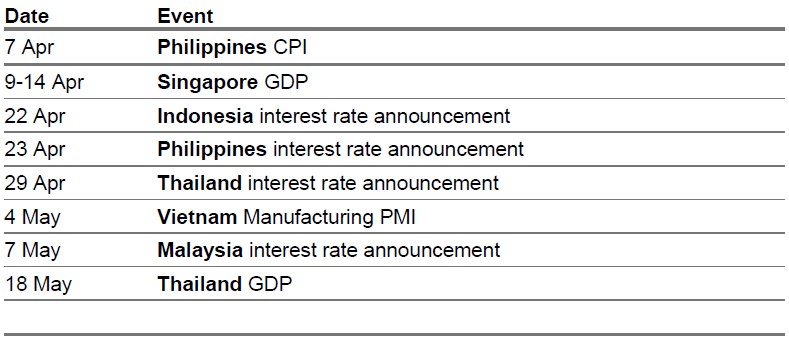
Key upcoming events

Source: LSEG Eikon, HSBC

Indonesia

Growth urgency

GDP growth was the highest in 13 quarters

GDP growth picked up to 5.4% y-o-y in the December quarter (versus 5% in the previous one), the highest in 13 quarters. Substantial fiscal and monetary policy easing had started showing up in indicators like credit growth and PMI manufacturing, even before the GDP print was released.

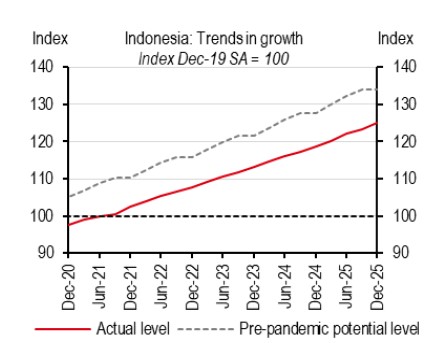
That said, we estimate that the economy continues to have a negative output gap (where actual GDP is less than its potential), and details suggest that households are running down saving, while cash-rich corporates are not investing. Furthermore, the fiscal deficit is already close to the 3% cap. And while there is space to cut rates, a volatile IDR is getting in the way. A string of domestic news around personnel changes amongst policy makers, concerns raised by credit rating agencies and MSCI, and news on fiscal sustainability, have raised market volatility across asset classes. As is well known, currency stability is a prime mandate for Bank Indonesia.

Higher oil prices could delay interest rate cuts

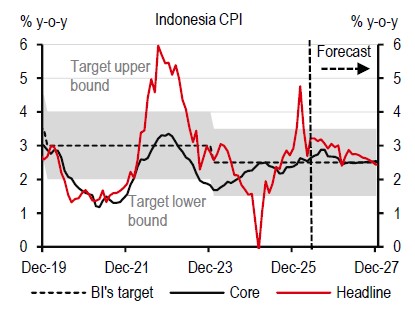
The Middle East tension is only exacerbating the situation. Indonesia’s net oil imports may be lower than the region’s (1.4% of GDP versus the 3% regional average), but so are its strategic domestic reserves (at 20-25 days of oil supply). A spike in prices can widen the current account deficit, stoke inflation, and hurt growth. The impact on inflation can be lower if the government subsidises oil prices for consumers. Still, cuts may have to be made in other areas to ensure that the deficit doesn’t rise too much. Meanwhile, higher oil prices could widen the current account deficit, keeping the currency volatile, and coming in the way of rate easing. We recently lowered our GDP growth forecast for the year to 4.7% (from 5.2%), which assumes oil prices to average USD80/b in 2026.

Prioritising tax and trade reforms can benefit growth

An obvious way to get higher and more sustainable growth would be to prioritise fiscal reforms. For instance, on the tax revenue front, improving VAT compliance and strengthening administration through better data use can help. Danantara, the new Sovereign Wealth Fund, is expected to manage the country’s SOEs efficiently, act as a vehicle for investment, and over time, transfer higher dividends to the government. For this to take shape, Danantara must be professionally run, with strong governance independence, or there may be concerns of rising quasi-fiscal debt.

And it’s not just fiscal reforms. Indonesia has embarked on important trade reforms, such as finalising more trade deals with the world (e.g., the EU and US trade deal in 2025 and 2026, respectively). But much more needs to be done here, if the country wants to truly benefit from the China + 1 opportunity, just as some other ASEAN economies are.

Indonesia’s persistent negative output gap

Source: CEIC, HSBC

Inflation is elevated now; likely to fall back closer to target in 2027

Source: CEIC, HSBC

Malaysia

The perks of an energy exporter

Trade and private consumption are flourishing

As a relatively mature emerging market, Malaysia saw strong growth of above 5% for two consecutive years, above its potential growth rate. This made Malaysia the second-fastest growing economy in ASEAN. Beyond rosy GDP number, what is more encouraging is how broad-based growth is, thanks to strong trade and resilient domestic demand.

Despite facing 19% US tariff in 2025, Malaysia’s trade jumped to a record high, largely benefitting from the AI-driven tech cycle. Over the past decade, Malaysia has gained substantial market share in certain semiconductors, including processor and amplifier chips, as well as parts of integrated circuits (IC). Meanwhile, private consumption continues to flourish, thanks to an improving labour market and some subsidies, while investment continues to grow at a double-digit pace.

While Malaysia is not insulated from the two biggest challenges – the tariff developments and the Middle East conflict, it is in a relatively better position to weather the storms in the Year of the Horse than its Asian peers. For one, the headline US tariff is now lower after the US Supreme Court’s decision than what Malaysia faced last year.

Malaysia is less impacted by the Middle East conflict

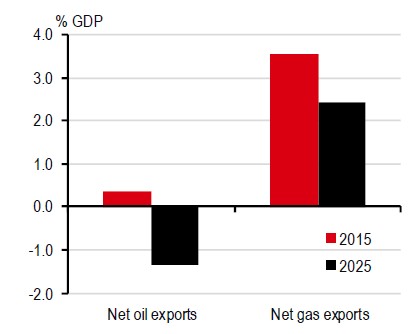
On the other hand, there is no better time to be a net energy exporter when it comes to the Middle East conflict. Malaysia, despite being a small net crude oil importer, is a large net natural gas exporter. Recall in 2022, when Malaysia benefitted from elevated global commodity prices and a chip crunch, growth ultimately hit 9%, the fastest in ASEAN. Granted, there are stark differences with today and this does not mean there are no downside risks to growth. But on a relative basis, the impact on its economy is likely to be much smaller than that on regional peers that are heavily dependent on oil imports, most of which transit through the Straits of Hormuz.

We forecast GDP growth of 4.5% for this year

We were thinking of upgrading Malaysia’s GDP growth before the Middle East conflict, but fresh uncertainty prompted us to maintain our GDP growth forecast at 4.5% for 2026. Recently, the government also held off from raising its growth forecast range of 4-4.5% (The Star, 6 March).

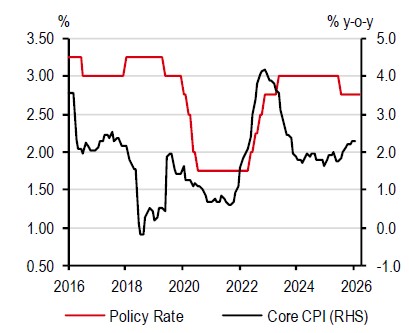
Elsewhere, inflation has largely remained benign, even though core inflation has picked up slightly to above 2% y-o-y. That said, there are still upside risks to inflation from the uncertain fate of subsidies for RON95 petrol. Overall, we have recently upgraded our headline inflation forecast to 2.1%, from 1.7%, for 2026. But we do not believe price pressures are significant enough to prompt Bank Negara Malaysia (BNM) to hike anytime soon.

Malaysia is a small net oil importer but a large net natural gas exporter

Source: CEIC, HSBC

Core inflation has picked up slightly above 2% y-o-y but is still benign

Source: CEIC, HSBC

Philippines

In a deeper jam

Growth surprised on the downside at 3% y-o-y in Q4

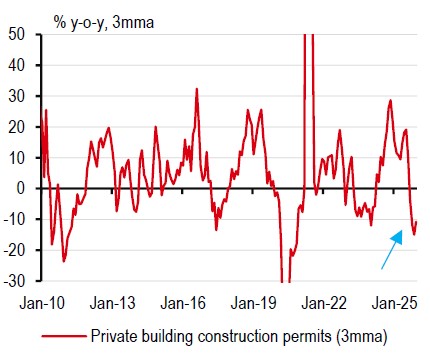
The Philippine economy was already caught in a jam even before the conflict in the Middle East escalated. The growth stumble, brought on by a fallout in public infrastructure spending, was already widely known, but the latest GDP figures emphasise the predicament. Growth surprised materially to the downside, slowing to 3.0% y-o-y in Q4 2025, the slowest since 2011, barring the COVID-19 pandemic. That’s understandable: as the government undertook an expansive corruption investigation, the slowdown in public spending pulled growth down by 2.1ppt. With a tenth of the labour force in construction, the drag in spending has trickled its way to households, with growth in private consumption clocking in its slowest pace since 2010, barring the pandemic. The labour market also was not spared. From the lows of 3.2%, the unemployment rate has risen to 5.8%.

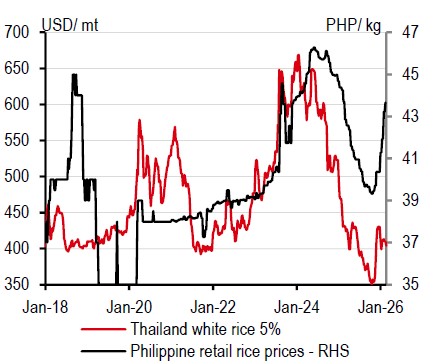
Headline inflation has finally returned to within the Bangko Sentral ng Pilipinas’ (BSP) 2-4% target band in February after 10 months of floating below it. But the inflation outlook turned grim when retail rice prices jumped by c10% since December. With rice being the heaviest component in the CPI basket, this jump in prices, if sustained, could increase inflation by 0.9ppt. 

Then the energy crisis, brought on by the conflict in the Middle East, came in. This represents a headwind to both growth and inflation, complicating the jam the economy already finds itself in. Growth-wise, every 10% increase in global oil prices represents a 0.4% of GDP incremental cost to the Philippines, which is above the average in Asia. On the inflation front, readers don’t need to look far; in the 2022-2023 oil shock, inflation jumped to as high as 8.7% y-o-y, the highest in ASEAN then.

We forecast inflation at 4% this year

Under our baseline scenario of global oil prices easing to USD80/b after a significant spike from USD120/b, we recently increased our full-year inflation forecast for 2026 to 4.0% from 2.4%. This implies that year-on-year inflation will eventually breach the BSP’s 2-4% target band for half of the year, thus necessitating a monetary response. This is despite the mounting challenges to growth: we expect full-year growth in 2026 to remain below potential for another year at 4.6% (from 5.2%). However, as the economy deals with many uncertainties and challenges, some of its fundamentals

should improve. The slowdown in public spending should, eventually, lead to a narrower current account deficit and less public debt. The timing may not be ideal, but it’s a silver lining, nonetheless.

The fallout in public capital spending has spilled over to private demand

Source: CEIC, HSBC

Rice prices spiked in February, altering the inflation outlook

Source: Macrobond, HSBC

Singapore

The fiscal bullets are there

Singapore’s robust trade bolstered GDP growth

Singapore, a developed market, is growing like an emerging market. For the past two years, it has generated impressive growth of around 5%, surpassing its potential growth. This reflects Singapore’s status as a bastion of trade, which has helped it withstand the tariff impact imposed by the US.

But we have entered the Year of the Horse with unprecedented challenges, and Singapore is not immune. After the US Supreme Court ruled the use of IEEPA tariffs unconstitutional, the US administration announced the imposition of a global 10% tariff under Section 122, valid for 150 days unless Congress extends the tariff. Meanwhile, the US administration has also launched a range of Section 301 investigations that could lead to additional tariffs. While this leaves Singapore exposed, robust AI hardware demand globally should help provide some cushion against the impact.

The Middle East conflict may weight on consumption

However, the bigger challenge has surfaced from the Middle East conflict. The direct mechanism of transmission to growth would be through erosion of consumption power via rapidly rising oil prices, as Singapore is heavily dependent on oil and gas imports. Meanwhile, it also poses downside risks to petroleum-related sectors, with Singapore being a hub for refining.

4Q25 GDP growth of almost 7% y-o-y was pushed up by the impressive performance of electronics. Therefore, we recently upgraded our GDP growth forecast to 2.9%, from 2%, for 2026, which is around the mid-point of the government’s revised forecast range of 2-4%. That said, the downside risk to growth will likely intensify if the Middle East crisis drags on.

We forecast core inflation of 1.8% in 2026

Outside of growth, inflation is another source of concern. Core inflation started 2026 with a downside surprise, coming in at only 1% y-o-y, but upside risks remain high. Recall, Monetary Authority of Singapore (MAS)-style core inflation includes energy-related components, like electricity prices, which are sensitive to volatility in global natural gas prices. We raised our core inflation forecast to 1.8% after the MAS meeting in January. Despite the downside surprise in the January core inflation, we keep our yearly forecast at 1.8% for 2026. The impact from higher oil prices is likely to be more evident from 3Q26, as there is usually a one-quarter impact lag on core inflation. We have already pencilled in the MAS policy normalisation to start in April, but we are adding one more round of tightening in October, likely bringing the SGD Nominal Effective Exchange Rate (NEER) slope to 1.5% by end-2026.

Singapore has benefitted from an AI-driven tech upturn for its chip exports

Source: CEIC, HSBC

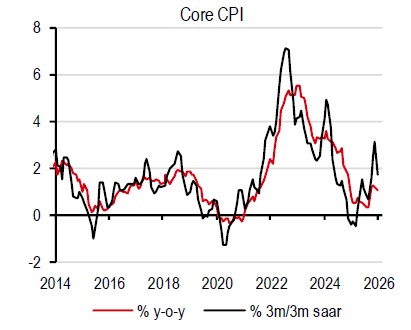
Singapore’s core inflation momentum has been quickly building up

Source: CEIC, HSBC

Thailand

Majority government

Bhumjaithai won enough seats to form a majority

A significant turn of events for the Land of Smiles. After three years of political instability, during which Thailand saw three prime ministers pass the baton, the conservatives in government surprised even the pre-election polls. These surveys predicted that the progressive People’s Party would win the most seats in Parliament but come short of garnering a majority and electing a prime minister. The February election then came and the conservatives, led by the Bhumjaithai Party, not only won more seats than the People’s Party, but they also won enough seats to form a majority on their own. Unlike in previous years, there is no hung Parliament. Instead, Thailand has likely garnered a renewed sense of political stability, with Anutin Charnvirakul of the Bhumjaithai Party continuing his role as Prime Minister.

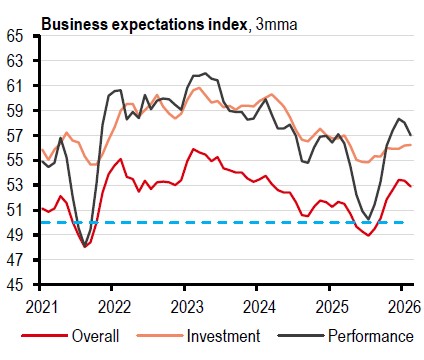
Business confidence has improved

This renewed sense of stability has provided financial markets some comfort. Apart from a stable government increasing certainty over policy, stability can also give any government the foundation to pursue long-term economic policies and reform in contrast to short-term, but costly, stimulus measures. As a result, business confidence has already improved from the trough of last year, while there are hopes that the billions of baht pledged in FDI could finally find their way to Thailand’s shores. These pledges are low-hanging fruits to boost growth – we estimate THB800 billion (or 4% of GDP) worth of FDI pledges that have yet to materialise.

Private investment and private consumption are driving growth

Though there is no exact date for when the next government will officially begin, the incoming administration will be inheriting an economy with positive momentum – or so we thought. Growth in 4Q 2025 exceeded expectations, driven by strong private investment. Private consumption as well has re-emerged as a major driver of growth, with consumption accelerating since the implementation of the ‘Half-Half’ subsidy scheme in October 2025.

However, the surge in oil prices, brought by the conflict in the Middle East, will be the next administration’s first major hurdle. Anutin Charnvirakul, in his capacity as a caretaker Prime Minister, is already at work: the caretaker government has put a cap on diesel prices until the end of March to mitigate inflation, with the cost of maintaining the ceiling borne by the Oil Fuel Fund.

Given all the moving parts, we recently adjusted our growth forecast to 1.6% in 2026 (from 1.7%). In addition, Thailand’s exposure to oil also makes its inflation outlook susceptible to changes in global oil prices; hence, we also increased our inflation forecast for 2026 to 1.2% (from 0.6%).

After years of continuous decline, business expectations turned the corner

Source: Macrobond, HSBC

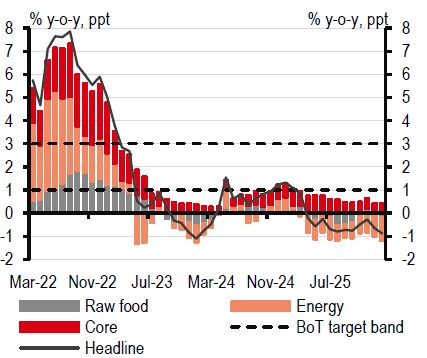
Monetary policy has room to absorb a price shock with inflation negative

Source: CEIC, HSBC

Vietnam

Sensitive to oil

Vietnam’s growth reached 8% in 2025 supported by exports

While 2025 was a rollercoaster year for Vietnam, it defied tariff concerns with growth hitting 8%. This easily placed Vietnam as the growth champion in ASEAN and the second-fastest growing economy in Asia, just after Taiwan.

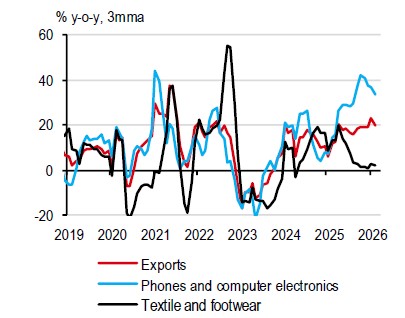
Although Vietnam was widely expected to be one of the economies with high US tariff risks, its trade was not disrupted but instead ballooned to a record high. Its trade surplus also remained sizeable. Despite facing a 20% headline tariff from the US, Vietnam captured even more market share for certain goods, such as footwear, textiles and consumer electronics. The positive trade momentum has been sustained in 2026, with exports growing 18% y-o-y in the first two months. 

That said, soon after the Year of the Horse arrived, two imminent challenges have emerged. The tariff development after the IEEPA tariff was ruled unconstitutional by the US Supreme Court brought some tailwinds for Vietnam’s trade, as now the country is facing a lower tariff rate (though new tariffs loom on the horizon). Vietnam has not yet signed a trade deal with the US, providing itself with some negotiation flexibility. Ultimately, much will depend on the tariffs that Vietnam will face relative to its competitors, although the country remains highly competitive.

Higher oil may hit consumers and trade

The Middle East conflict poses immediate headwinds to Vietnam’s growth, as it is sensitive to global oil prices, and is heavily dependent on oil imports from the Middle East. If high oil prices were to persist, it may erode consumers’ purchasing power significantly, with household spending only starting to see a gradual recovery not so long ago. In addition, rising oil prices will translate into higher production and shipping costs for industry and trade, which are the growth pillars for Vietnam.

We forecast GDP to grow at 6.5% in 2026

All in all, we recently trimmed our GDP growth forecast to 6.5% for 2026 (from 6.7%), but the downside risks are intensifying, depending on how long the Middle East conflict drags on.

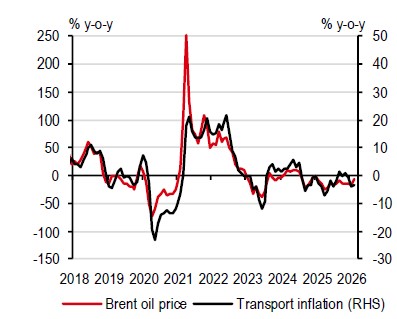
This conflict also poses major upside risks to inflation. Based on PVOIL’s data, RON95 on 19 March 2026 has increased over 50% from the end of February, pushing up inflation significantly. Thus, we have recently upgraded our headline inflation forecast to 4.3%, from 3.5%, for 2026. But if oil prices remain high, this may risk pushing inflation above the 4.5% ceiling set by the State Bank of Vietnam (SBV).

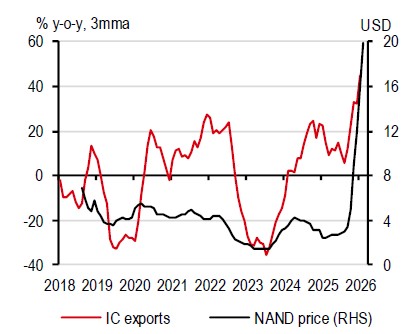
Vietnam’s exports continue to be driven by strong electronics shipments

Source: CEIC, HSBC

History reminds us of the acute impact of high oil prices on Vietnam’s inflation

Source: CEIC, HSBC

More Insights from Fund Managers
More videos on how HSBC Global Asset Management connects you to global investment opportunities
Sign up for our newsletter
Never miss market updates. Receive a summary of our latest insights directly in your inbox each week

Related Insights

China’s 4.5-5.0% GDP target supports a strong start to the 15th FYP with room for reform...[18 Mar]
There’s been plenty of talk about China’s anti-involution campaign, but so far tangible...[23 Feb]
An investment rebound is around the corner, supported by the new wave of government...[20 Jan]
With exports galloping ahead, much of ASEAN delivered resilient growth in recent...[22 Dec]

Disclosure appendix

Additional disclosures

1. This report is dated as at 30 March 2026.

2. All market data included in this report are dated as at close 25 March 2026, unless a different date and/or a specific time of day is indicated in the report.

3. HSBC has procedures in place to identify and manage any potential conflicts of interest that arise in connection with its Research business. HSBC's analysts and its other staff who are involved in the preparation and dissemination of Research operate and have a management reporting line independent of HSBC's Investment Banking business. Information Barrier procedures are in place between the Investment Banking, Principal Trading, and Research businesses to ensure that any confidential and/or price sensitive information is handled in an appropriate manner.

4. You are not permitted to use, for reference, any data in this document for the purpose of (i) determining the interest payable, or other sums due, under loan agreements or under other financial contracts or instruments, (ii) determining the price at which a financial instrument may be bought or sold or traded or redeemed, or the value of a financial instrument, and/or (iii) measuring the performance of a financial instrument or of an investment fund.

Disclaimer

This document is prepared by The Hongkong and Shanghai Banking Corporation Limited (‘HBAP’), 1 Queen’s Road Central, Hong Kong. HBAP is incorporated in Hong Kong and is part of the HSBC Group. This document is distributed by HSBC Continental Europe, HBAP, HSBC Bank (Singapore) Limited, HSBC Bank (Taiwan) Limited, HSBC Bank Malaysia Berhad (198401015221 (127776-V))/HSBC Amanah Malaysia Berhad (200801006421 (807705-X)), The Hongkong and Shanghai Banking Corporation Limited, India (HSBC India), HSBC Bank Middle East Limited, HSBC UK Bank plc, HSBC Bank plc, Jersey Branch, and HSBC Bank plc, Guernsey Branch, HSBC Private Bank (Suisse) SA, HSBC Private Bank (Suisse) SA DIFC Branch, HSBC Private Bank Suisse SA, South Africa Representative Office, HSBC Financial Services (Lebanon) SAL, HSBC Private banking (Luxembourg) SA and The Hongkong and Shanghai Banking Corporation Limited (collectively, the “Distributors”) to their respective clients. This document is for general circulation and information purposes only. This document is not prepared with any particular customers or purposes in mind and does not take into account any investment objectives, financial situation or personal circumstances or needs of any particular customer. HBAP has prepared this document based on publicly available information at the time of preparation from sources it believes to be reliable but it has not independently verified such information. The contents of this document are subject to change without notice. HBAP and the Distributors are not responsible for any loss, damage or other consequences of any kind that you may incur or suffer as a result of, arising from or relating to your use of or reliance on this document. HBAP and the Distributors give no guarantee, representation or warranty as to the accuracy, timeliness or completeness of this document. This document is not investment advice or recommendation nor is it intended to sell investments or services or solicit purchases or subscriptions for them. You should not use or rely on this document in making any investment decision. HBAP and the Distributors are not responsible for such use or reliance by you. You should consult your professional advisor in your jurisdiction if you have any questions regarding the contents of this document. You should not reproduce or further distribute the contents of this document to any person or entity, whether in whole or in part, for any purpose. This document may not be distributed to any jurisdiction where its distribution is unlawful.

The following statement is only applicable to HSBC Bank (Taiwan) Limited with regard to how the publication is distributed to its customers: HSBC Bank (Taiwan) Limited (“the Bank”) shall fulfill the fiduciary duty act as a reasonable person once in exercising offering/conducting ordinary care in offering trust services/business. However, the Bank disclaims any guaranty on the management or operation performance of the trust business.

The following statement is only applicable to by HSBC Bank Australia with regard to how the publication is distributed to its customers: This document is distributed by HSBC Bank Australia Limited ABN 48 006 434 162, AFSL/ACL 232595 (HBAU). HBAP has a Sydney Branch ARBN 117 925 970 AFSL 301737.The statements contained in this document are general in nature and do not constitute investment research or a recommendation, or a statement of opinion (financial product advice) to buy or sell investments. This document has not taken into account your personal objectives, financial situation and needs. Because of that, before acting on the document you should consider its appropriateness to you, with regard to your objectives, financial situation, and needs.

Important Information about the Hongkong and Shanghai Banking Corporation Limited, India (“HSBC India”)

HSBC India is a branch of The Hongkong and Shanghai Banking Corporation Limited. Incorporated in Hong Kong SAR with limited liability. HSBC India is an AMFI-registered Mutual Fund Distributor of select mutual funds and a referrer of other 3rd party investment products. HSBC India does not distribute or refer investment products to those persons who are either the citizens or residents of United States of America (USA), Canada or any other jurisdiction where such distribution or referral would be contrary to law or regulation.

HSBC India will receive commission from HSBC Asset Management (India) Private Limited, in its capacity as a AMFI registered mutual fund distributor of HSBC Mutual Fund. The Sponsor of HSBC Mutual Fund is HSBC Securities and Capital Markets (India) Private Limited (HSCI), a member of the HSBC Group. Please note that HSBC India and the Sponsor being part of the HSBC Group, may give rise to real, perceived, or potential conflicts of interest.

HSBC India has a policy in place to identify, prevent and manage such conflict of interest For more information related to investments in the securities market, please visit the SEBI Investor Website: https://investor.sebi.gov.in/ and the SEBI Saa₹thi Mobile App. Mutual Fund investments are subject to market risks, read all scheme related documents carefully. Issued by The Hongkong and Shanghai Banking Corporation Limited, India. Incorporated in Hong Kong SAR with limited liability. HSBC Bank ARN - 0022 with validity from 19-Feb-2024 to 18-Feb-2027. Date of initial registration: 19-Feb-2002.

Mainland China

In mainland China, this document is distributed by HSBC Bank (China) Company Limited (“HBCN”) and HSBC FinTech Services (Shanghai) Company Limited to its customers for general reference only. This document is not, and is not intended to be, for the purpose of providing securities and futures investment advisory services or financial information services, or promoting or selling any wealth management product. This document provides all content and information solely on an "as-is/as-available" basis. You SHOULD consult your own professional adviser if you have any questions regarding this document.

The material contained in this document is for general information purposes only and does not constitute investment research or advice or a recommendation to buy or sell investments. Some of the statements contained in this document may be considered forward looking statements which provide current expectations or forecasts of future events. Such forward looking statements are not guarantees of future performance or events and involve risks and uncertainties. Actual results may differ materially from those described in such forward-looking statements as a result of various factors. HSBC India does not undertake any obligation to update the forward-looking statements contained herein, or to update the reasons why actual results could differ from those projected in the forward-looking statements. Investments are subject to market risk, read all investment related documents carefully.

© Copyright 2026. The Hongkong and Shanghai Banking Corporation Limited, ALL RIGHTS RESERVED.

No part of this document may be reproduced, stored in a retrieval system, or transmitted, on any form or by any means, electronic, mechanical, photocopying, recording or otherwise, without the prior written permission of The Hongkong and Shanghai Banking Corporation Limited.

Important information on sustainable investing

“Sustainable investments” include investment approaches or instruments which consider environmental, social, governance and/or other sustainability factors (collectively, “sustainability”) to varying degrees. Certain instruments we include within this category may be in the process of changing to deliver sustainability outcomes.

There is no guarantee that sustainable investments will produce returns similar to those which don’t consider these factors. Sustainable investments may diverge from traditional market benchmarks. In addition, there is no standard definition of, or measurement criteria for sustainable investments, or the impact of sustainable investments (“sustainability impact”). Sustainable investment and sustainability impact measurement criteria are (a) highly subjective and (b) may vary significantly across and within sectors.

HSBC may rely on measurement criteria devised and/or reported by third party providers or issuers. HSBC does not always conduct its own specific due diligence in relation to measurement criteria. There is no guarantee: (a) that the nature of the sustainability impact or measurement criteria of an investment will be aligned with any particular investor’s sustainability goals; or (b) that the stated level or target level of sustainability impact will be achieved.

Sustainable investing is an evolving area and new regulations may come into effect which may affect how an investment is categorised or labelled. An investment which is considered to fulfil sustainable criteria today may not meet those criteria at some point in the future.